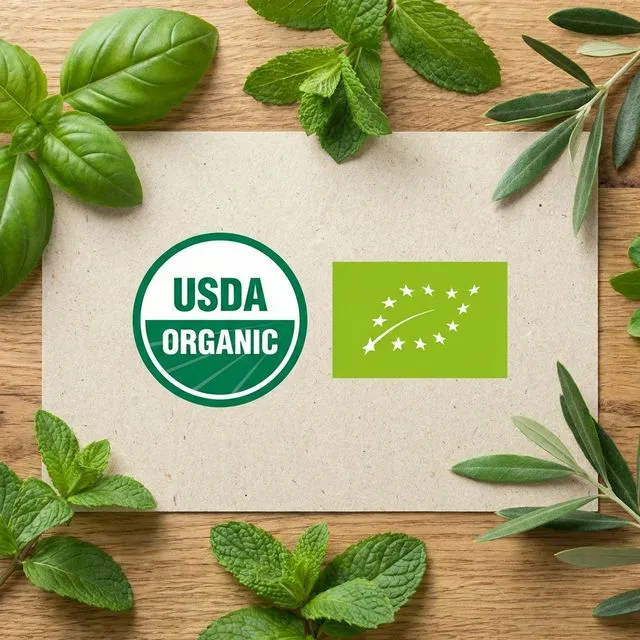
The Value of “Organic”
Consumer demand for organic products continues to grow globally. For manufacturers, carrying the “Organic” seal is a trust signal that implies safety, sustainability, and quality. But what does it take to get there?
USDA NOP (National Organic Program)
The USDA Organic seal is the standard for the United States. Key requirements include:
- No Synthetic Pesticides: Farming must rely on natural substances.
- No GMOs: Genetically modified organisms are strictly prohibited.
- Soil Quality: Land must have been free of prohibited substances for at least 3 years prior to harvest.
EU Organic Regulation
The EU Organic leaf logo is mandatory for pre-packaged organic food products in the European Union. While similar to USDA, there are subtle differences in:
- Pesticide Residue Limits: The EU can have stricter limits on certain contaminants.
- Hydroponics: Generally not allowed in EU organic farming, but permitted in some USDA contexts.
Equivalence Arrangements
Fortunately for global trade, the US and EU have an organic equivalence arrangement. This means that products certified to USDA NOP standards can generally be marketed as organic in the EU, and vice versa, without needing duplicate certifications (with some specific exceptions).
Why Source Certified Ingredients?
- Traceability: Every batch can be traced back to the farm.
- Safety: Rigorous third-party audits ensure no harmful chemicals are used.
- Marketing: You cannot legally use the word “Organic” on your main display panel without certification.
At ToNutra, our core catalog—including our Wheat Grass, Pea Protein, and more—is dual-certified for both USDA NOP and EU Organic standards, ensuring your products are ready for the global market.